
Waterfall Islands: What to Know Before You Commit
Short answer: a waterfall island is one where the countertop keeps going past the edge and runs straight down the side to the floor, so the slab looks like it pours over the end. It's a striking, modern look — but the whole thing lives or dies on fabrication. Two details matter most: the mitered corner where the top folds into the leg, and the vein-matching that lets the pattern flow continuously around that corner. It works in almost any material — marble, quartzite, porcelain, or quartz — and it costs more than a standard island because of the extra slab, the miter, and the careful handling. If you want one, the single best decision you'll make is choosing a shop that mitres and vein-matches well. We build them often — here's what to know first.
By Leo Chuahy · Prime Surfaces — founder and certified installer (Neolith, Dekton, Porcelanosa & Daltile Panoramic)
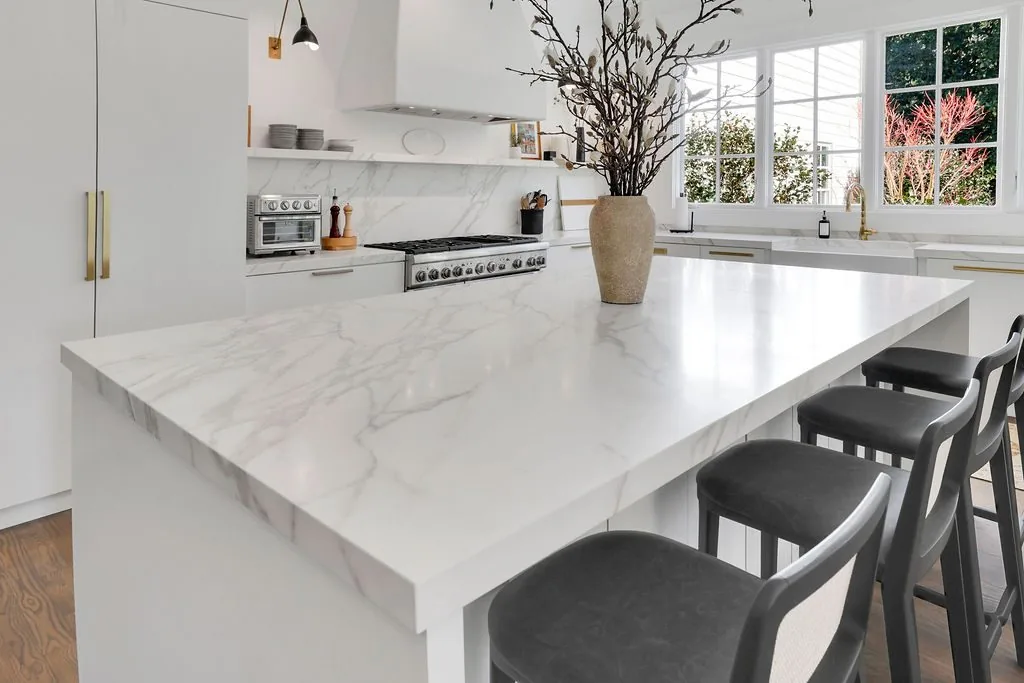
What exactly is a waterfall island?
On a standard island, the countertop stops at the edge and the end of the cabinet is finished in wood or a painted panel. On a waterfall island, the same surface — stone, quartz, or large-format porcelain — turns the corner and continues vertically down one or both ends to the floor. The effect is a single, sculptural block that looks like the slab folded over the edge. It's clean, architectural, and it makes the island the centerpiece of the kitchen. The same idea shows up on bar tops, bench seats, and feature counters, but the island is where it earns its name.
What is a mitered edge, and why is it the whole game?
The corner is everything. A mitered edge is made by cutting both the top and the vertical leg at a 45-degree angle and joining them so the seam lands exactly on the corner. Done right, the thickness of the slab disappears and the corner reads as one solid piece of stone bending over the edge. Done poorly, you get a chunky, mismatched, or chipped corner and a visible glue line. A good miter is precise, labor-intensive work — it's the clearest fingerprint of a skilled fabricator, and the first thing we'd tell you to inspect on anyone's waterfall.
Does the veining really flow around the corner?
On a well-made waterfall, yes — and that continuous flow is usually the entire reason to choose one. Because the vertical leg is cut from the slab right where the top ends, the pattern can be vein-matched so it appears to pour over the mitered corner and down to the floor without a break. This takes planning before any cut: extra slab, careful layout, and sometimes a second slab so the right section is available. It's the same craft behind a book-matched fireplace. Not every slab allows a perfect match, but on marble, quartzite, and movement-rich porcelain, nailing the vein-match is what makes people stop and stare.
Which material is best for a waterfall?
All of them can waterfall; the best depends on the look and how hard the island works. Marble and quartzite give the most dramatic, continuous natural-stone veining for that folded look (quartzite with far less upkeep than marble — see our quartzite vs. marble guide). Large-format porcelain is ideal for a thin, seamless, ultra-modern edge and shrugs off heat and scratches. Quartz gives a consistent, predictable pattern and the easiest maintenance, though its uniform look vein-matches less dramatically. Because we install all three families, our recommendation follows your project, not our inventory.
Why does a waterfall cost more?
Three drivers, and it's worth understanding them. Material: the legs use extra slab, and vein-matching often means buying more stone — sometimes a whole second slab — so the right section can be cut. Fabrication: the mitered corners are precise, time-consuming work a square edge never needs. Handling: the finished legs are heavy and the corners are fragile, so transport and install take extra care. We don't price waterfalls off a per-square-foot rule of thumb, because slab yield and miters vary so much — the honest number comes from your actual island size, material, and layout. (For how edges, cutouts, and details move a quote in general, our cost guides go deeper.)
Does it need extra structural support?
Yes — planned before install, not improvised. The vertical legs carry real weight, and the mitered corner relies on a solid, square, level substructure underneath to stay tight over the years. The cabinet base or a built framework has to be strong and true, and on a large island or one with a seating overhang we'll often add concealed steel or bracketing so nothing flexes or cracks. This is a coordination detail between fabricator and builder, best settled while the island is still being framed.
One side or two — and how far down?
Both are design calls. A single waterfall end reads as a deliberate accent and uses less material; a double waterfall on both ends gives the fully symmetrical, monolithic block many modern kitchens want. Waterfalls almost always run to the floor — that's what creates the poured effect — though a leg can stop at a toe-kick reveal or appear to float for a lighter feel. The right answer depends on the room, the sightlines, the budget, and whether there's seating on one side. We'll lay out the options with you before a slab is committed.
The Prime Surfaces take
A waterfall island is proof-of-craft — its entire value is in the mitered corner and the vein-match being executed properly, so it's a feature you should only buy from a shop that does them well. Coming from the slab side of the business, we plan the layout and the miter before a single cut, so the stone really does appear to fold and flow to the floor. We'll also tell you honestly when a particular slab won't vein-match cleanly, or when a single waterfall end serves the room better than two. Bring us the island dimensions and the look you're after, and we'll show you what's possible in the material you love.
FAQ
What is a waterfall island?
A waterfall island is a kitchen island where the countertop material doesn't stop at the edge but continues straight down one or both sides to the floor, so the slab looks like it pours over the end like a sheet of water. Instead of a finished wood or painted panel on the end of the island, you see the same stone, quartz, or porcelain running vertically to the floor. It's a clean, modern, architectural look that turns the island into a single sculptural block, and it's one of the most popular upgrades we're asked for on kitchen islands and bars.
What is a mitered edge, and why does it matter on a waterfall?
A mitered edge is how the top of the island meets the vertical leg at the corner. The two pieces are each cut at a 45-degree angle and joined so the seam sits right on the corner, giving a crisp, continuous edge with no visible slab thickness or butt joint. Done well, the corner looks like one solid piece of stone folding over the edge. Done poorly, you get a thick, mismatched, or chipped corner. The miter is the single hardest part of a waterfall and the clearest sign of good fabrication, which is why it belongs with a skilled shop.
Does the veining really continue around the corner?
On a well-made waterfall, yes, and it's the detail that separates a stunning island from an ordinary one. Because the vertical leg is cut from the slab right where the top ends, the veining can be matched so the pattern appears to flow continuously over the mitered corner and down to the floor, as if the stone really did fold. This vein-matching takes extra slab, careful layout, and planning before a single cut is made. Not every material or slab allows a perfect match, but on marble, quartzite, and book-matchable porcelain it's often the whole point of choosing a waterfall.
Which countertop material is best for a waterfall island?
All of the main surfaces can be done as a waterfall, and the best one depends on your priorities. Marble and quartzite give the most dramatic, continuous veining for that folded-stone look. Large-format porcelain is excellent for a thin, seamless, modern edge and is very durable. Quartz offers a consistent, predictable look and easy maintenance. The practical catch is that a waterfall needs a material and slab with enough size and movement to vein-match, and a fabricator comfortable mitering it. We install all of these, so we'll match the material to the look you want and how the island will be used.
Why does a waterfall island cost more than a standard one?
Three things drive it. First, material: the vertical legs use additional slab, and vein-matching often means buying more stone so the right section can be cut, sometimes a second slab. Second, fabrication: the mitered corners are precise, labor-intensive work that a standard square edge doesn't require. Third, handling and install: the finished legs are heavy and the corners are vulnerable, so they take extra care to transport and set. We don't quote waterfalls by a rule-of-thumb per-square-foot number because the slab yield and the miters vary so much; the honest figure comes from your actual island size, material, and layout.
Does a waterfall island need extra structural support?
It needs proper support, planned before install. The vertical legs carry real weight and the mitered corner relies on a solid, square substructure underneath, so the cabinet base or a built framework has to be level, plumb, and strong enough to bear the stone and keep the miter tight over time. On a large island or one with a seating overhang, we may add concealed steel or bracketing so nothing flexes or cracks. This is exactly the kind of detail that should be worked out between the fabricator and the builder up front, not improvised on install day.
One waterfall side or two, and does it have to reach the floor?
Both are design choices with no single right answer. A single waterfall end reads as an intentional accent and uses less material; a double waterfall on both ends gives the fully symmetrical, monolithic block look many modern kitchens want. Waterfalls almost always run to the floor, since that's what creates the poured effect, but you can stop a leg at a toe-kick reveal or float it for a lighter look. The decision depends on the room, the sightlines, your budget, and whether the island has seating on one side. We'll mock up the options with you before committing a slab.
Are waterfall islands still in style, and are they worth it?
Waterfall islands have moved from a trend to a lasting, modern-classic detail, and they remain one of the most-requested features in high-end kitchens. Whether one is worth it comes down to the material and the fabrication: a waterfall is proof-of-craft, so its whole value is in the mitered corner and the vein-match being done right. A beautifully executed waterfall in good stone is a genuine showpiece that lifts the whole kitchen; a poorly mitered or mismatched one looks worse than a plain finished end. If you want one, the money is well spent on a fabricator who does them well.
Can you build a waterfall island from our designer's or builder's plans?
Yes. We regularly fabricate and install waterfall islands working with homeowners, interior designers, and builders, and we can work from drawings or an existing cabinet base. Because the miter and the vein-match have to be planned before any cutting, the earlier we're involved the better the result, ideally while the island dimensions and support are still being set. We offer both source-and-install for homeowners and designers and install-only for builders who supply their own slab. Send us the island size, the material you're considering, and the look you're after, and we'll take it from there.
Thinking about a waterfall island?
Send us your island size and the material you're drawn to — we'll plan the miter and the vein-match and show you what's possible before a slab is committed.