
Large-Format Porcelain: Pros, Cons & Cost in Atlanta
Short answer: large-format porcelain (also called sintered stone) is the toughest, most versatile countertop surface we install — heat-, scratch-, stain-, and UV-resistant, non-porous, never needs sealing, and the only surface rated for outdoor use. Its trade-offs are real too: premium lines sit toward the higher end of countertop pricing, and because the slabs are thin and very hard, they demand a skilled, certified installer to handle edges and seams well. On cost, most large-format porcelain runs roughly $100 to $150 per square foot installed in the Atlanta area — with waterfall legs, a full-height backsplash, mitered edges, or a more involved apartment/high-rise install pushing toward the top of that range or a little above, and simpler layouts landing nearer the bottom. These are preliminary ranges, not firm quotes: the exact number depends on the slab, finish, square footage, seams, and cutouts, so we confirm it after templating. Below, a shop that fabricates and installs it every day walks through the pros, the cons, and exactly what moves the price — then how to get a real Atlanta range.
By Leo Chuahy · Prime Surfaces — founder and certified installer of Neolith, Dekton, Porcelanosa & Daltile Panoramic
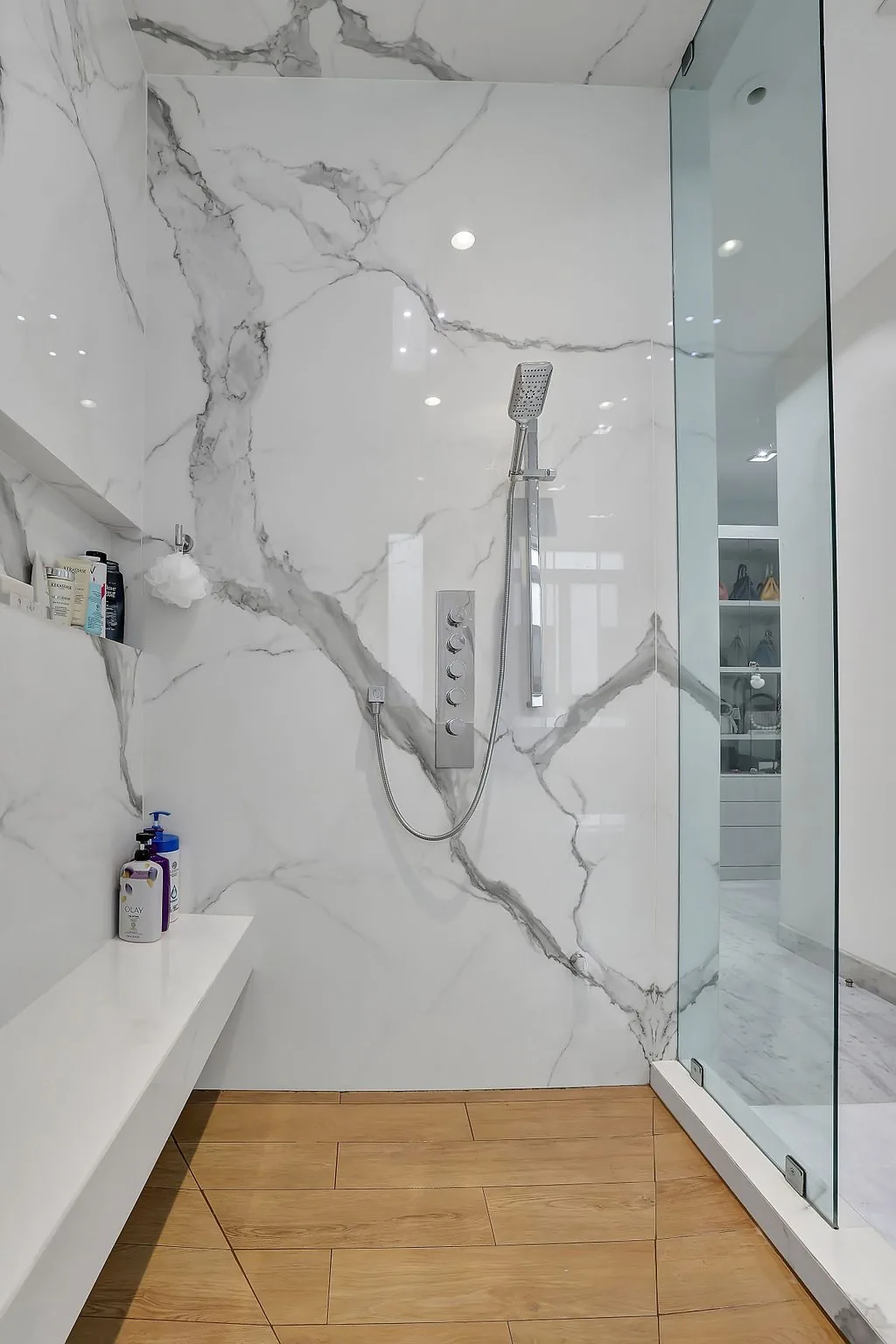
What is large-format porcelain (sintered stone)?
Large-format porcelain is an ultra-compact surface made from natural minerals compacted and fired at over 2,000°F into a dense, thin slab. Brands like Neolith, Dekton, and Porcelanosa come in very large panels — big enough for seamless counters, full-height walls, fireplaces, and even building façades — in thicknesses from about 6mm up to 20mm or more. “Sintered stone” and “large-format porcelain” are used interchangeably for countertops; both describe the same high-fired, non-porous material. It’s a different category from both natural stone and engineered quartz, and it’s the most technically demanding of the three to fabricate and install.
What are the pros of large-format porcelain?
Durability across the board. It’s the most heat-resistant surface we install — you can set a hot pan on it without scorching — and it’s extremely scratch-, stain-, and UV-resistant. No sealing, ever, because it’s non-porous. Outdoor-rated, the only engineered surface that is, which is why it owns outdoor kitchens and exterior cladding. Seamless scale, since the slabs are large enough to clad a whole island, wall, or chimney breast with very few seams. And realistic looks, with marble- and stone-look designs that are hard to tell from the real thing. For a head-to-head on toughness, see our porcelain vs. quartz guide.
What are the cons of large-format porcelain?
Being honest about the trade-offs: it’s harder to fabricate and install than any other countertop, because the thin, hard slabs can chip on an unsupported edge and any weak seam or overhang shows — so it demands a skilled, certified installer, not a standard drop-off. Premium lines cost more than entry-level quartz or granite. And because the most realistic stone look lives in the slab’s surface layer, deeply profiled edges need careful detailing (often a mitered edge) to keep the veining consistent. None of these are reasons to avoid porcelain — they’re the reasons experience matters. Done by the right crew, the cons effectively disappear into a flawless finished surface.
How much does large-format porcelain cost in Atlanta?
Straight answer: most large-format porcelain countertops run roughly $100 to $150 per square foot installed in the Atlanta area. Where you land in that range — or a little above it — comes down to the details: waterfall legs, a full-height backsplash, mitered edges, and a more involved install (an apartment or high-rise versus a single-level house) all add labor and push toward the top end, while a simpler layout sits nearer the bottom. Porcelain is priced like a premium surface — the better sintered-stone designs cost more than entry-level lines — and with porcelain more than most surfaces, the fabrication and install expertise is a real part of the number, because the material is demanding to handle. Treat these as preliminary ranges, not a firm quote: we confirm the real figure from the actual slab and a templated measure of your project, not a rule of thumb.
What drives the price up or down?
Think of the price as the slab plus the work. On the slab side: the brand, the specific design, the thickness, and the finish (polished, silk, or matte). On the work side: total square footage, the number and style of edges, sink and cooktop cutouts, the number of seams, and whether you want a waterfall island or a full-height backsplash. Porcelain’s large panels can actually work in your favor on big runs by reducing seams. Two kitchens of identical size can price very differently once these details are counted — it’s how one lands near the bottom of that range and another toward the top or above — which is exactly why we template and quote rather than guess.
Is it worth the price?
For the right project, porcelain is often the best long-term value despite a higher upfront cost. If you’re building an outdoor kitchen, a façade, a full-height feature wall, or a hard-working family kitchen that’ll see hot pans and heavy use, the heat, UV, scratch, and stain resistance — with zero sealing — pay off for decades. If you just want a uniform indoor counter at a friendly price, quartz may be the smarter spend. Because we install porcelain, quartz, and natural stone, our recommendation follows your project, not our inventory.
Why the installer matters more than the brand
This is the part that gets overlooked. With large-format porcelain, fabrication and installation quality affects the outcome more than which premium brand is on the slab. Thin, hard sheets are unforgiving of mishandling, poor substrate support, or a bad seam plan — the difference between a flawless result and a chipped edge is the crew, not the logo. As a certified installer of Neolith, Dekton, Porcelanosa, and Daltile Panoramic, we bring the tooling and technique this material requires. If you’re weighing two porcelain lines, our Neolith vs. Dekton guide breaks down where they differ.
FAQ
How much do large-format porcelain countertops cost in Atlanta?
Most large-format porcelain countertops run roughly $100 to $150 per square foot installed in the Atlanta area. Details push you within that range, or a bit above it: waterfall legs, a full-height backsplash, mitered edges, and a more involved install (an apartment or high-rise versus a single-level house) all add labor and move you toward the top end, while simpler layouts land nearer the bottom. These are preliminary ranges, not a firm quote. The exact number depends on the specific slab, thickness, finish, total square footage, seams, and cutouts, so we confirm it after a templated measure of your project.
Why is porcelain more expensive than some other countertops?
Two reasons. First, premium sintered-stone lines like Neolith and Dekton are high-performance materials with realistic stone looks, and the better designs carry a higher slab cost. Second, and more often overlooked, large-format porcelain is harder to fabricate and install: the thin, large slabs require specialized tooling, careful handling, mitered edges, and a skilled crew. You're paying for the install expertise as much as the slab. That same difficulty is why choosing an experienced, certified installer matters more with porcelain than with almost any other surface.
Is large-format porcelain worth the cost?
For the right project, yes. Porcelain is the most heat-, scratch-, stain-, and UV-resistant surface we install, it never needs sealing, and it's the only one rated for outdoor use — so for an outdoor kitchen, a façade, a full-height feature wall, or a hard-working family kitchen, it often delivers the best long-term value despite a higher upfront price. For a simple indoor counter where you want a uniform look at a friendly price, quartz may be the more sensible spend. The right answer depends on how you'll use the surface.
What are the cons of large-format porcelain?
The main trade-off is fabrication: because the slabs are thin and very hard, a sharp impact on an unsupported edge can chip them, and a poorly planned seam or overhang will show — so it demands a skilled, certified installer rather than a standard countertop shop. Premium lines also cost more than entry-level quartz or granite, and the realistic stone-look pattern is printed on the surface layer, so deeply profiled edges need careful handling to keep the look consistent. None of these are reasons to avoid porcelain — they're reasons to use an experienced installer.
Is porcelain cheaper than quartz, quartzite, or marble?
The ranges overlap heavily and depend far more on the specific slab and the fabrication scope than on the category name. Entry-level quartz and many granites are usually the friendliest starting point; premium porcelain, exotic quartzite, and rare marble sit toward the top. A premium porcelain and a premium quartz can land at similar numbers. The only way to compare fairly is to price the actual slabs you like for your actual project — which is exactly what a quote does.
What drives the installed price up or down?
The slab itself (brand, design, thickness, finish), the total square footage, and then the fabrication scope: the number and style of edges, sink and cooktop cutouts, the number of seams, whether you want a waterfall island or a full-height backsplash, and how much on-site handling the layout requires. Porcelain's large, thin sheets also mean fewer seams on big runs, which can work in your favor. Two kitchens of the same size can price very differently once these details are accounted for.
Can large-format porcelain be used for outdoor kitchens in Georgia?
Yes — and it's the best choice for it. Porcelain is UV-stable and freeze-thaw stable, so unlike quartz it won't fade or degrade in direct Georgia sun, and it handles our humidity and temperature swings without issue. That's why it's used for exterior façades and outdoor kitchens. If your project is outdoors or sees direct sunlight, porcelain is effectively the only engineered surface that belongs there.
Does porcelain need sealing or special maintenance?
No sealing, ever — it's non-porous. Everyday care is mild soap and water or a pH-neutral cleaner and a soft cloth; skip abrasive pads and harsh chemicals. You can set a hot pan on it without scorching, and it resists scratches and stains as well as anything we install. The one habit worth keeping is cutting on a board — mostly to protect your knives and to avoid sharp impacts on edges. For a surface this tough, the maintenance is about as low as it gets.
Want a real porcelain number for your project?
Tell us the slab you like and the scope — kitchen, outdoor kitchen, or façade — and we’ll get you a preliminary Atlanta range, then a firm price after templating.