
Granite vs. Quartz: Is Granite Outdated?
Short answer: granite is not outdated — the busy, speckled builder-grade granite of the 2000s is what fell out of fashion, while dramatic, marble-like, and bold statement granites are firmly back in high-end kitchens. The real decision between granite and quartz isn’t about style, it’s about how they behave. Granite is natural stone: extremely hard, genuinely heat-resistant, and one-of-a-kind in every slab, but porous, so it needs periodic sealing. Quartz is engineered: non-porous, never needs sealing, and consistent in look, but its resin binder is heat-sensitive, so trivets are a must, and it can’t go outdoors. Want natural character and heat tolerance? Granite. Want the lowest maintenance and a uniform look? Quartz. We install both — here’s the honest comparison.
By Leo Chuahy · Prime Surfaces — founder, with a stone-slab sourcing background (Brazil, Spain & Italy); we fabricate and install granite, quartz & large-format porcelain
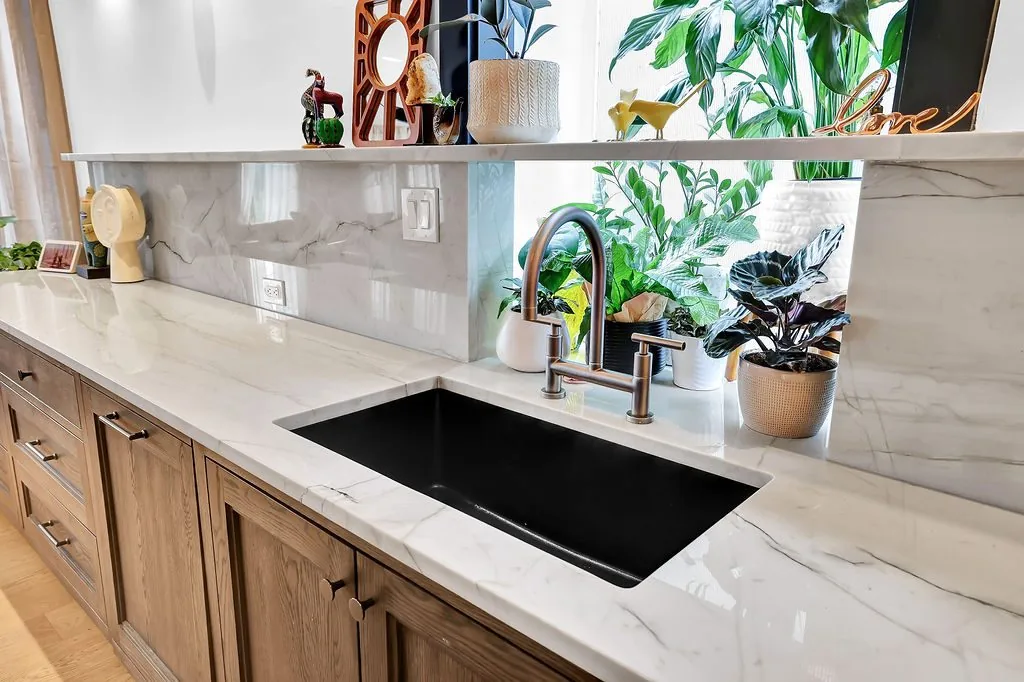
Is granite actually outdated?
This is the question behind the question, so let’s answer it directly: no. What’s dated is one look — the flecked, high-movement tan-and-black granite that went into millions of spec homes in the 2000s. It became so ubiquitous it started to read as generic, and that’s what people mean when they say granite feels old. But granite is a whole category of natural stone, and the current generation of exotic granites — soft whites and greys with marble-like veining, dramatic blacks, and bold statement blocks — is very much in demand in luxury kitchens. Because it’s natural stone, no two slabs are identical, which is exactly the uniqueness designers have circled back to. If your mental image of granite is a builder-grade counter, the slabs on today’s racks will change your mind.
What’s the difference between granite and quartz?
Granite is 100% natural igneous stone, quarried and cut into slabs. It’s one of the hardest surfaces you can put in a kitchen, it handles heat beautifully, and every slab is geologically unique. Because it’s natural, it’s porous, so it’s sealed at installation and re-sealed periodically. Quartz is engineered — roughly 90% ground natural quartz bound with resins and pigments. That resin makes quartz non-porous and maintenance-free (no sealing, strong stain resistance, a consistent look), but it’s also the weak point: resin is sensitive to heat and to prolonged sun. One is a piece of the earth; the other is manufactured to be predictable. Almost every practical difference below flows from that.
Does granite or quartz need sealing?
Granite needs sealing; quartz never does. Most granite is porous enough to benefit from a sealer at installation and periodic re-sealing after that — though some very dense granites need it rarely. Don’t guess on a schedule; use the water test: drip a little water on the surface, and if the stone darkens within a few minutes, it’s time to re-seal. Quartz is non-porous, so there’s nothing for a sealer to penetrate — applying one can leave a haze. If maintenance is your top concern, this is a point for quartz. Our guide on whether your stone needs sealing covers the details.
Which is more heat-resistant?
Granite, clearly. It was formed under extreme heat, so a hot pan won’t scorch or discolor it — we still suggest a trivet to protect the sealer and guard against thermal shock, but granite is forgiving. Quartz is not: the resin binder can scorch, yellow, or crack from a pan straight off the burner, and heat damage is excluded from most quartz warranties. If your household cooks hard and sets cookware down without thinking, granite removes a real risk. This is one of granite’s clearest wins, matched among our materials only by large-format porcelain.
Which is more durable and scratch-resistant?
Both are very durable, and in everyday use you’d be hard-pressed to hurt either. Granite is one of the hardest countertop materials and strongly scratch-resistant; quartz is also hard and resists everyday wear well. The practical difference is what can go wrong: granite’s vulnerability is staining if it’s under-sealed, while quartz’s vulnerabilities are heat and sun, not scratches or stains. You should cut on a board on either surface — mostly to protect your knives. For pure toughness in a busy kitchen, both earn their keep; granite edges ahead on heat, quartz on stain-proof convenience.
Which looks better — and gives more design options?
This is where taste decides. Granite gives you genuine, unrepeatable geology — real depth, crystalline sparkle, and veining no factory can reproduce, so your counter is literally one of a kind. Quartz gives you control: consistent color across the whole run, predictable patterns, and colors (including bright pure whites) that are hard to find in natural stone, with the pattern carried through so edges and cutouts stay uniform. If you want authentic natural character, granite; if you want a clean, controllable, repeatable look, quartz. Neither is more “premium” — they’re different aesthetics.
Which is more expensive?
The ranges overlap so heavily that “granite vs. quartz” isn’t a useful way to think about price. Entry-level granite and entry-level quartz are both accessible; exotic, rare granites and premium designer quartz lines both sit at the top. What actually drives installed cost is the specific slab, the thickness, the edge profile, the number of cutouts, and whether you’re doing a waterfall or a full-height backsplash — the fabrication, in other words, as much as the stone. That’s why a real quote beats any price-per-square-foot rule of thumb. Tell us the slabs you like and we’ll price them honestly.
So which should you choose — the honest answer?
Choose granite if you want real natural stone with genuine heat resistance and a one-of-a-kind look, and you don’t mind sealing it now and then — and don’t write it off as dated until you’ve seen today’s exotic slabs. Choose quartz if you want the lowest-maintenance surface made, a consistent controllable look, and never want to think about sealing — just commit to trivets and keep it indoors. Because we fabricate and install both (plus porcelain and other natural stone), our recommendation follows your kitchen and how you live in it, not a single product line. If you’re also weighing natural stone against quartz more broadly, our quartz vs. quartzite and porcelain vs. quartz vs. natural stone guides go deeper.
FAQ
Is granite out of style?
No — granite itself isn't out of style; a specific look is. The busy, speckled builder-grade granite that went into millions of kitchens in the 2000s became so common it started to read as dated, and that's what people are reacting to when they say granite looks old. The material is very much back in high-end kitchens, just in different form: dramatic, marble-like, or bold statement slabs with movement and character. As a natural stone, no two slabs are alike, which is exactly the appeal designers have rediscovered. If your idea of granite is the flecked tan-and-black counter from a 2005 spec house, today's exotic granites will surprise you.
Is granite or quartz better for a kitchen?
Both are excellent kitchen surfaces — the right one depends on your priorities. Granite is a natural stone that's extremely hard, handles heat very well, and gives you one-of-a-kind veining, but it's porous so it needs periodic sealing. Quartz is engineered, non-porous, and never needs sealing, with a consistent, controllable look, but its resin binder is heat-sensitive so you must use trivets. If you want natural character and true heat resistance, choose granite; if you want the lowest maintenance and a uniform look, choose quartz. We install both and match the material to how you actually cook.
Does granite need to be sealed?
Usually yes, though it varies by the specific granite. Most granite is porous enough to benefit from sealing at installation and periodic re-sealing after that, while some very dense granites absorb so little they need it rarely, if ever. Rather than following a fixed calendar, use the water test: drip a little water on the surface, and if the stone darkens within a few minutes, it's time to re-seal; if it beads, you're fine. Areas around the sink and cooktop wear faster and should be checked first. Quartz, by contrast, never needs sealing because it's non-porous.
Can you put a hot pan on granite or quartz?
On granite, it tolerates heat very well because it's natural stone formed under heat — but we still recommend a trivet to protect the sealer and guard against thermal shock over time. On quartz, never set a hot pan directly on the surface: the resin that binds engineered quartz can scorch, discolor, or crack, and heat damage is excluded from most quartz warranties. This is one of granite's real advantages. If your household routinely sets hot cookware down without thinking, granite — or large-format porcelain — is the more forgiving choice.
Which is more expensive, granite or quartz?
The ranges overlap heavily and depend far more on the specific slab, color, thickness, and the fabrication your project needs than on the category name. Entry-level granite and entry-level quartz are both budget-friendly; exotic, rare granites and premium designer quartz lines both sit at the top. Installed cost is driven by edges, cutouts, waterfalls, and seams as much as by the stone itself, so the honest number comes from a real quote rather than a price-per-square-foot rule of thumb. We'll price the exact slabs you're considering.
Does quartz look fake compared to granite?
Not the way it used to. Early quartz could look flat and repetitive, but today's premium quartz uses sophisticated veining and movement that reads convincingly like marble or natural stone, especially from normal viewing distance. That said, quartz is manufactured, so its pattern repeats and is predictable — which some people love for its clean consistency and others find less characterful than natural stone. Granite gives you genuine, unrepeatable geology in every slab. If authentic, one-of-a-kind natural material matters to you, granite delivers it; if you prefer a controlled, uniform look, quartz is the strength.
Which lasts longer, granite or quartz?
Both are built to last decades and neither realistically wears out in a normal kitchen. Granite is one of the hardest countertop materials, highly scratch- and heat-resistant, and can last a lifetime with periodic sealing. Quartz is very durable indoors and non-porous, so it resists stains without sealing, but it can be damaged by high heat and can fade in direct sun, making it strictly indoor. In practice, longevity comes down to care: seal granite when the water test says so, and use trivets on quartz. Do that and either surface outlives most kitchen remodels.
Can granite or quartz be used outdoors?
Granite can be used outdoors and holds up well to sun and weather, which makes it a common choice for outdoor kitchens and grill surrounds, though it should be sealed and maintained. Quartz cannot — direct sunlight fades and discolors many quartz colors and can weaken the resin over time, and most quartz warranties specifically exclude outdoor use. If your project is an outdoor kitchen or anywhere with strong direct sun, granite is an option, but large-format porcelain is our top recommendation because it's fully UV- and freeze-thaw-stable. See our porcelain page for more.
Related guides: Quartz vs. Quartzite · Porcelain vs. Quartz vs. Natural Stone · Does Your Stone Need Sealing?
Deciding between granite and quartz?
Send us your project and we’ll show you the exact slabs that fit — and tell you honestly which surface suits how you actually cook and live.