
Full-Height Backsplashes: Slab vs. Tile
Short answer: a full-height backsplash runs from the counter all the way to the underside of the upper cabinets — or higher on an open wall — instead of the usual short 4-inch strip, and you can do it in slab or tile. Choose a slab backsplash when you want a seamless, dramatic expanse of stone or porcelain with almost no grout, often matched to the counter so the veining flows up the wall; it's the easiest to clean but costs more because it adds material. Choose tile when you want pattern, texture, color options, or a friendlier budget, accepting grout lines that need upkeep. Neither is universally "better" — they're different looks. We fabricate and install both, so here's the honest comparison to help you decide.
By Leo Chuahy · Prime Surfaces — founder and certified installer (Neolith, Dekton, Porcelanosa & Daltile Panoramic)
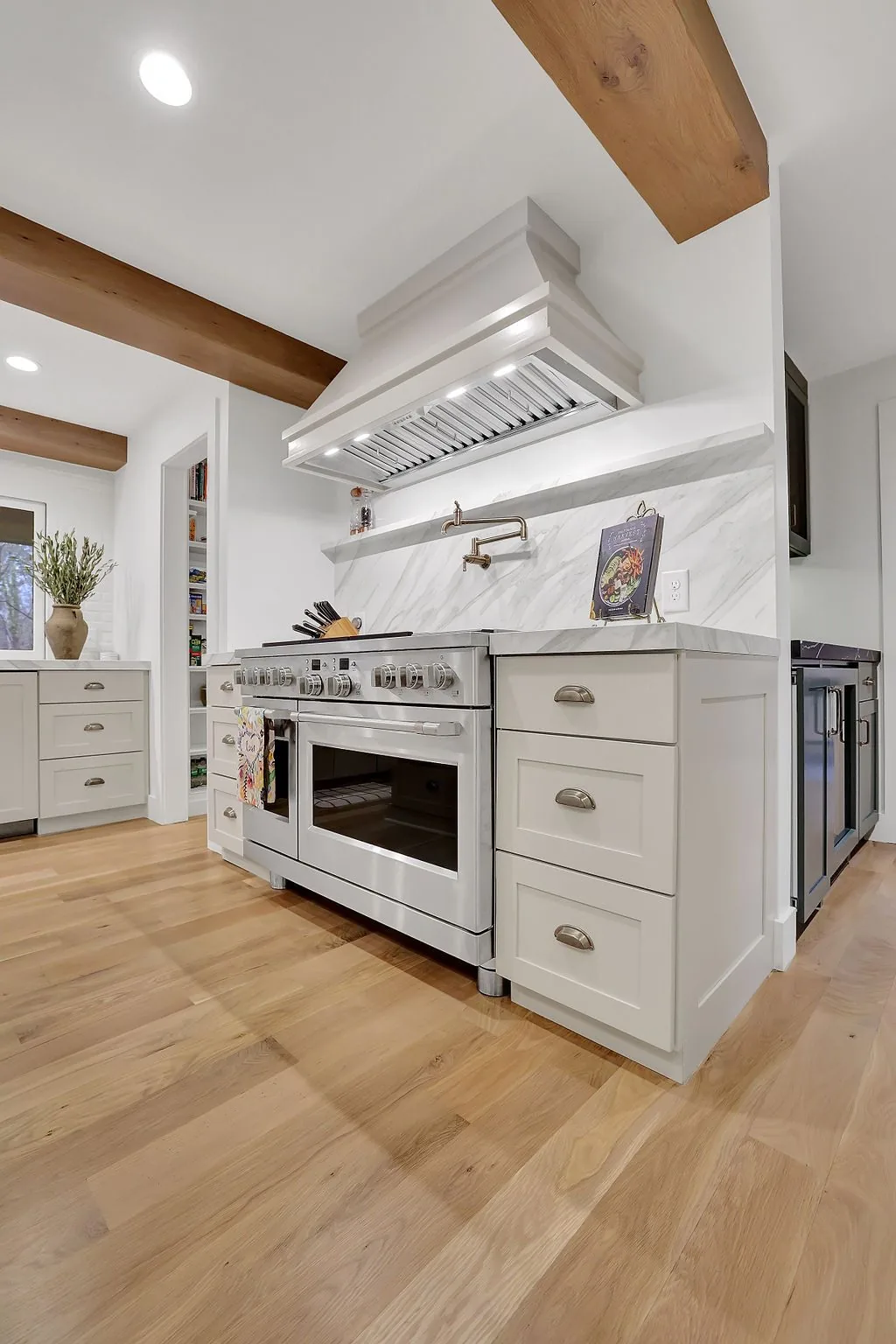
What is a full-height backsplash?
A standard backsplash is a short strip — usually about four inches — of material above the counter. A full-height backsplash carries that surface all the way up to the underside of the upper cabinets, and on a wall with no uppers it can run higher still, to the hood or even the ceiling. You can do it as a single slab of stone, quartz, or large-format porcelain, or as tile covering the full height. Either way, it turns the wall behind your counters and range into a deliberate design moment rather than an afterthought — which is why it's become one of the most-requested upgrades in the kitchens we build.
Slab or tile — which should you choose?
They create genuinely different looks, so the "right" one depends on what you're after. A slab backsplash gives a seamless, uninterrupted expanse with little to no grout — often matched to the counter for a monolithic, high-end effect — and it's the easiest surface in the kitchen to wipe down. Tile gives you pattern, texture, color, and budget flexibility, and it's the move when you want a handmade, classic, or graphic look — at the cost of grout lines that need upkeep. A simple way to decide: if you want seamless drama and continuity with the counter, go slab; if you want pattern, texture, or a specific tile aesthetic, go tile.
Is a full-height slab backsplash worth it?
For the right wall, often yes. A full-height slab swaps a short strip for a whole wall of material, so it adds square footage and sometimes a second slab to carry the veining — which makes it pricier than a standard backsplash or most tile (our guide on what actually drives countertop cost breaks down why). What you get back is a seamless, high-impact feature with minimal grout to clean and strong continuity with the counter. It tends to earn its keep on a focal wall, behind a range, or anywhere dramatic veining can flow up from the countertop. On a long, plain run with no feature intent, tile may give you better value for the money.
Can the backsplash match the countertop slab?
Yes — and it's one of the most striking things we do. Running the counter material up the wall creates a continuous, monolithic look, and with careful layout the veining can be matched so the pattern appears to flow from the countertop straight up the backsplash. That continuity is the whole appeal, and it's the same craft behind a waterfall island or a book-matched fireplace wall. It does take planning and often extra material: to carry the pattern up, we may need more of the stone — sometimes a second slab — and the layout has to be set before anything is cut. Coming from the slab side of the business, that layout step is where we spend our time.
Which materials work best?
All the main surfaces can do a full-height backsplash; the best one depends on the look and how the wall is used. Large-format porcelain is often ideal — big, thin panels cover a full wall with few or no seams, it's heat- and stain-resistant behind a range, and it never needs sealing. Quartz gives a consistent, low-maintenance look that matches a quartz counter cleanly. Natural stone — marble, quartzite — delivers the most dramatic matched veining, with the usual trade-off that porous stone should be sealed and marble can etch. If low maintenance leads your list, see our porcelain vs. quartz vs. natural stone guide for the full comparison.
How do seams and outlets work on a slab backsplash?
On many kitchens, a full-height slab wall can be done with no seam at all — large-format porcelain and oversized slabs cover a typical backsplash in one piece, which is a big part of the appeal. On a long or tall wall, or with a smaller slab, a seam may be unavoidable; we place it where your eye won't land and plan the layout so any veining still reads as continuous. Outlets, switches, a window, a hood, or a pot-filler are all cut into the slab precisely, which is why it pays to coordinate those locations with your builder or designer early — the cleaner the plan, the cleaner the wall.
Is one harder to clean than the other?
Here the slab wins clearly. A slab backsplash is a smooth, near-seamless expanse with little or no grout, so cooking splatter behind the range wipes off with mild soap and water or a pH-neutral cleaner — one of the easiest surfaces in the whole kitchen to maintain. A tile backsplash is perfectly cleanable too, but its grout lines collect grease and grime over time, need periodic attention, and may want sealing. If a grout-free, low-maintenance surface behind the stove matters to you, that's a point firmly in slab's column. For how to keep any surface looking new, see our countertop care guide.
The Prime Surfaces take
A full-height backsplash is one of the highest-impact upgrades in a kitchen, and the slab-versus-tile call really comes down to the look you want and how the wall is used. If you're drawn to a seamless, dramatic surface that flows from the counter and practically cleans itself, a slab — especially in porcelain or a well-matched stone — is hard to beat, and it's exactly the kind of fabrication we love to plan. If you want texture, pattern, or a tighter budget on a long wall, tile is the honest answer, and we install that too. Tell us the counter you're considering and the wall you want to cover, and we'll lay both options against it before you commit — working directly with homeowners and designers, or install-only for builders who supply their own material.
FAQ
What is a full-height backsplash?
A full-height backsplash runs the backsplash all the way from the countertop up to the underside of the upper cabinets, instead of the usual short 4-inch strip. On a wall with no uppers, it can run even higher, often to the hood or the ceiling. It can be done two ways: as a single slab of the same (or a coordinating) material as your counter, or as tile covering the full height. The full-height approach has become one of the most popular kitchen upgrades because it reads as intentional and high-end and gives you a large, uninterrupted design moment behind the range and counters.
Slab or tile for a full-height backsplash — which is better?
Neither is universally better; they create different looks. A slab backsplash gives a seamless, dramatic, uninterrupted expanse of stone or porcelain with little to no grout, often matched to the counter for a monolithic effect, and it's the easiest to wipe clean. Tile offers more pattern, texture, color, and budget flexibility, and it's a strong choice when you want a handmade or classic look, but it introduces grout lines that need maintenance. If you want seamless drama and continuity with the counter, go slab; if you want pattern, texture, or a specific tile aesthetic, go tile. We install both and will show you each against your counter.
Is a full-height slab backsplash worth the cost?
For many kitchens, yes, provided the material and the layout justify it. A full-height slab replaces a short strip with a wall of material, so it adds square footage and sometimes a second slab to carry the veining, which makes it more expensive than a standard backsplash or most tile. What you get is a seamless, high-impact feature with minimal grout to clean, strong continuity with the counter, and a genuinely custom look. It tends to be most worth it on a focal wall, behind a range, or where dramatic veining can flow up from the counter. On a long, plain wall, tile may give better value.
Can you run the same slab as the counter up the wall?
Yes, and it's one of the most striking things we do. Running the counter material up the wall as a full-height slab creates a continuous, monolithic look, and with careful layout the veining can be matched so the pattern appears to flow from the countertop up the backsplash. That continuity is the whole appeal, but it takes planning and often extra material: to carry the pattern up the wall, we may need more of the stone, sometimes a second slab, and the layout has to be set before cutting. It's the same vein-matching craft behind a waterfall island or a book-matched feature wall.
Which materials work best for a full-height slab backsplash?
Large-format porcelain is often the ideal choice: it comes in big, thin panels that cover a full wall with few or no seams, it's heat- and stain-resistant behind a range, and it never needs sealing. Quartz gives a consistent, low-maintenance look and matches a quartz counter cleanly. Natural stone like marble and quartzite delivers the most dramatic veining for a matched, flowing look, with the usual trade-off that porous stone should be sealed and marble can etch. The best pick depends on the look you want and how the wall is used, especially behind a cooktop. Because we install all of them, our recommendation follows your project.
Do full-height slab backsplashes have seams?
Sometimes, depending on the wall size and the slab. Large-format porcelain and oversized slabs can often cover a typical backsplash wall with no seam at all, which is a big part of the appeal. On a long or tall wall, or with a smaller slab, a seam may be needed, and we place it where it's least visible and plan the layout so any veining still reads continuously. Outlets, switches, and a window or hood opening are cut into the slab precisely. The goal is the cleanest possible expanse with seams, when unavoidable, put where your eye won't land.
Are full-height backsplashes hard to clean?
A slab backsplash is one of the easiest surfaces in the kitchen to clean, because it's a smooth, near-seamless expanse with little or no grout, so splatter behind the range wipes off with mild soap and water or a pH-neutral cleaner. That low-maintenance, grout-free quality is a major reason people choose slab behind a cooktop. A tile backsplash is also perfectly cleanable, but its grout lines collect grease and grime over time and need periodic attention, and grout may want sealing. If easy cleanup behind the stove is a priority, slab has the edge.
Can you install a full-height backsplash behind a range or cooktop?
Yes, and it's one of the best places for one. A full-height slab behind a range gives you a bold focal point and a smooth, grout-free surface that's easy to keep clean of cooking splatter. Heat-resistant materials like large-format porcelain and most natural stone handle the location well; we plan clearances around the range and hood and cut any openings precisely. It's worth coordinating early with your builder or designer on the hood, outlets, and any pot-filler so everything lines up cleanly in the slab. This is exactly the kind of focal detail a full-height backsplash is made for.
Planning a full-height backsplash?
Tell us the counter you're considering and the wall you want to cover — we'll lay slab and tile options against it and help you choose before anything is cut.